

As industries look for practical ways to improve environmental performance, packaging has become an important part of the conversation. The carbon footprint of packaging is influenced by the materials selected, how they are manufactured, how efficiently they are transported, and what happens to them after use.
For manufacturers, choosing the right Rigid Industrial Packaging is therefore not simply a matter of containment and durability. Material efficiency, manufacturing practices, packaging design and recyclability can all influence environmental impact.
What Is the Carbon Footprint of Rigid Industrial Packaging?
The carbon footprint of industrial packaging refers to the greenhouse gas emissions associated with producing, manufacturing, transporting and managing packaging throughout its lifecycle.
Three stages are particularly important.
First, raw material extraction and processing can generate significant emissions. Steel production, polymer production and tinplate processing each have different energy and emissions profiles.
Second, manufacturing consumes energy through processes such as forming, coating, welding and blow moulding.
Third, transportation contributes emissions through the movement of packaging and the products it contains.
The impact does not stop at manufacturing. Packaging design, product protection, reuse potential and end-of-life recycling can influence the overall footprint.
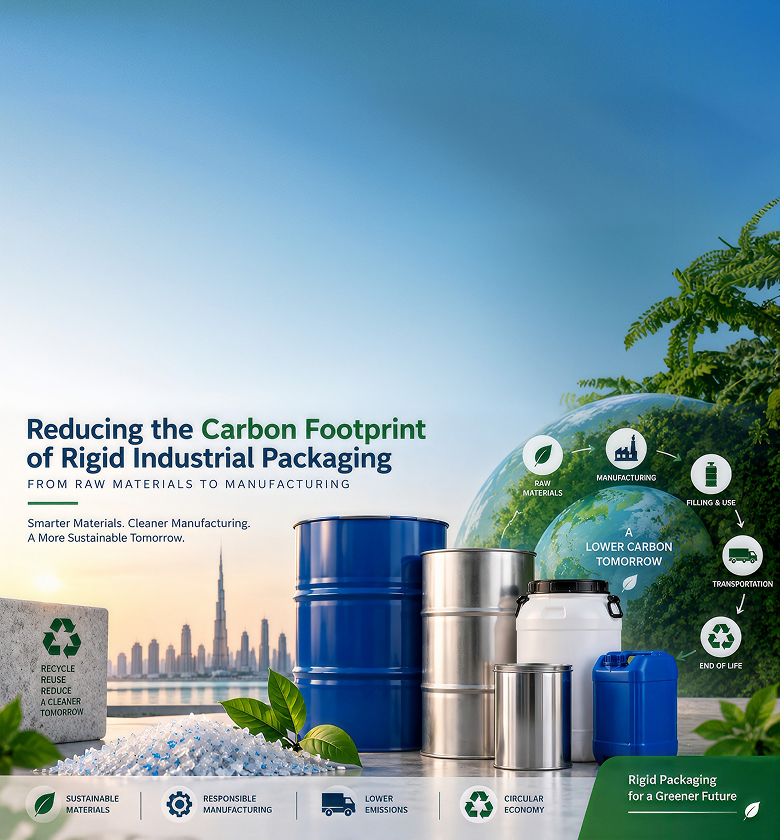
A useful way to understand this lifecycle is:
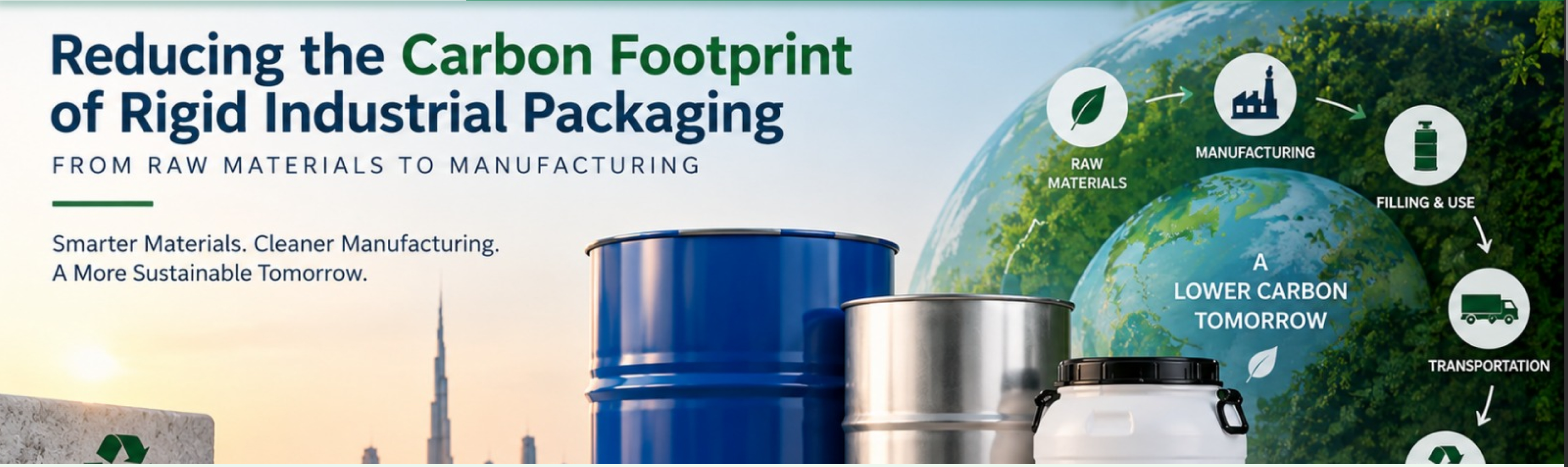
Raw materials → Manufacturing → Filling → Transportation → End of life
For this reason, evaluating Rigid Industrial Packaging requires a lifecycle perspective rather than focusing on one production stage alone.

Stage 1: Raw Materials and Their Carbon Impact
Raw material selection is one of the first opportunities to reduce carbon footprint across the packaging lifecycle.
Steel is energy-intensive to produce, but its established recycling infrastructure allows steel packaging to be recovered and recycled repeatedly. Its actual lifecycle impact depends on factors such as production technology, recycled content, packaging weight, transport and end-of-life recovery.
Tinplate combines a steel substrate with a thin protective coating. It provides strength, formability and recyclability, making it suitable for applications where durable metal packaging is required.
Plastic packaging presents a different consideration. Virgin HDPE is produced from fossil-based feedstocks, while recycled HDPE can reduce reliance on virgin resin. Using post-consumer recycled content, where technically and legally suitable, can therefore support material circularity and potentially lower the carbon impact associated with raw material production.
| Material | Carbon Consideration | Recyclability | Balmer Lawrie Product |
|---|---|---|---|
| Steel | Energy-intensive production; impact varies with recycled content and process | High recycling potential | Steel Drums |
| Tinplate | Steel-based material with protective coating | High recycling potential | Metal Cans |
| Virgin HDPE | Higher reliance on virgin fossil-based feedstock | Recyclable where collection exists | Plastic Drums |
| Recycled HDPE | Can reduce demand for virgin resin | Recyclable where systems exist | Plastic Drums |
A sustainable packaging manufacturer should therefore consider material efficiency, product performance, recycled content and end-of-life pathways together rather than selecting a material based on a single environmental metric.
For businesses exploring sustainable packaging dubai, the right material choice should always be matched to the product being packaged, required performance and available recycling infrastructure.
Stage 2: How Manufacturing Processes Affect Carbon Emissions
After material selection, manufacturing efficiency becomes another important factor. Industrial packaging production can involve steel forming and welding, tinplate processing, printing, coating and plastic blow moulding. Each process has its own energy requirements and opportunities for waste reduction.
Automation and process control can help manufacturers maintain dimensional consistency, improve production efficiency and minimise avoidable material waste. However, it is important not to assume that automation alone eliminates emissions. Energy sources, equipment efficiency, production volumes and process optimisation all influence the result.
Balmer Lawrie UAE is certified to ISO 14001:2015, an Environmental Management System standard. The certification supports a structured approach to managing environmental responsibilities and continual improvement. The company also holds ISO 45001:2018 for occupational health and safety.
From energy consumption and process efficiency to material waste and resource use, manufacturing decisions can contribute to a broader sustainability circular economy approach.
A practical sustainability strategy can include:
- Improving production efficiency
- Reducing avoidable material waste
- Optimising energy consumption
- Monitoring environmental performance
- Improving resource utilisation
- Designing products for effective end-of-life recovery
Stage 3: Packaging Design That Reduces Carbon in the Supply Chain
Packaging design can influence carbon emissions beyond the factory floor. Efficient designs can improve storage, handling and transportation while maintaining the required strength and protection.
For example, conical drum designs can support nesting, potentially allowing more empty packaging units to be transported within available vehicle space. This can improve logistics efficiency, although the actual carbon benefit depends on the complete supply-chain configuration.
Material optimisation is another consideration. Using only the material required to achieve the necessary performance can reduce material consumption without compromising package integrity. Packaging should not simply be made lighter; it should be engineered to provide the required strength, closure performance and product protection.
Proper packaging design can also prevent leakage, contamination and product damage. When packaged goods are damaged during handling or transport, additional products, packaging materials, energy and transportation may be required to replace them.
This is where rigid packaging solutions need to balance durability, material efficiency, logistics and product protection.
For businesses evaluating Green Packaging Dubai options, the objective should not be to choose the lightest package at any cost. The better approach is to select a design that provides the required performance with efficient use of materials and resources.
How Balmer Lawrie Is Reducing Carbon Footprint in UAE
Balmer Lawrie UAE identifies sustainability as a core part of its business direction and states that it aims to innovate eco-friendly packaging solutions, improve resource efficiency and explore renewable energy opportunities.
The company holds ISO 14001:2015 Environmental Management System certification, alongside ISO 9001:2015 and ISO 45001:2018 certifications. It also holds FSSC 22000 certification for food safety and has an Ecovadis sustainability rating.
These credentials do not mean that every packaging product has a zero carbon footprint. Instead, they demonstrate structured management systems and an ongoing focus on quality, environmental responsibility, safety and sustainability.
Balmer Lawrie UAE's three listed manufacturing locations also provide a regional manufacturing footprint across Dubai and Ras Al Khaimah.
For companies evaluating sustainable packaging in Dubai, working with an established local manufacturer can also support more informed decisions around packaging specifications, supply requirements and logistics.
Businesses searching for green packaging in Dubai should look beyond environmental terminology and assess measurable factors such as material efficiency, product durability, manufacturing practices, certifications and end-of-life options.
Steel vs Plastic: Which Has a Lower Carbon Footprint for Industrial Use?
There is no universal answer to whether steel or plastic has a lower carbon footprint. The result depends on material weight, recycled content, manufacturing energy, transportation, product requirements and end-of-life management.
Steel has a strong recycling advantage, while plastic can offer lightweight packaging and efficient material use. Recycled plastic content can further reduce dependence on virgin resin where suitable.
For manufacturers seeking to reduce carbon footprint, the best packaging choice is therefore the one that meets product and regulatory requirements while considering the complete lifecycle.
The right sustainable packaging manufacturer can help evaluate these factors rather than recommending a material based on one environmental characteristic.
Conclusion
Reducing packaging emissions requires more than changing one material. Raw material selection, manufacturing efficiency, packaging design, transportation and end-of-life recovery all contribute to the overall environmental impact.
For manufacturers, choosing appropriate rigid industrial packaging means balancing product protection, durability, regulatory requirements, material efficiency and sustainability objectives.
Balmer Lawrie UAE combines established manufacturing capabilities with environmental and quality management systems to support industrial packaging requirements across sectors.
If your business is looking to reduce carbon footprint through better packaging decisions, the right approach starts with understanding your product, supply chain and packaging lifecycle.
Ready to reduce the carbon footprint of your industrial packaging? Contact Balmer Lawrie UAE today.
Frequently Asked Questions
- What is the carbon footprint of industrial packaging?
The carbon footprint of industrial packaging includes emissions associated with raw material production, packaging manufacturing, transportation and end-of-life management. Material selection, energy use, packaging weight and recycling can all influence the total footprint.
- Is steel packaging more sustainable than plastic?
Not necessarily in every application. Steel has strong recycling potential, while plastic can provide lightweight packaging and efficient material use. The overall environmental impact depends on the complete packaging lifecycle.
- How does rigid industrial packaging reduce supply chain carbon emissions?
Efficient packaging design can improve transport and storage efficiency while protecting products from damage. Features such as nesting designs, material optimisation and appropriate packaging strength can help improve supply-chain efficiency.
- What certifications support sustainable industrial packaging manufacturing in UAE?
Balmer Lawrie UAE holds ISO 14001:2015 for environmental management, ISO 45001:2018 for occupational health and safety, and FSSC 22000 for food safety. The company also has an Ecovadis sustainability rating.
- How can manufacturers in the UAE reduce packaging carbon footprint?
Manufacturers can assess material selection, recycled content, packaging weight, manufacturing efficiency, transportation and end-of-life recovery. Working with a certified sustainable packaging manufacturer can also help businesses evaluate packaging requirements systematically.